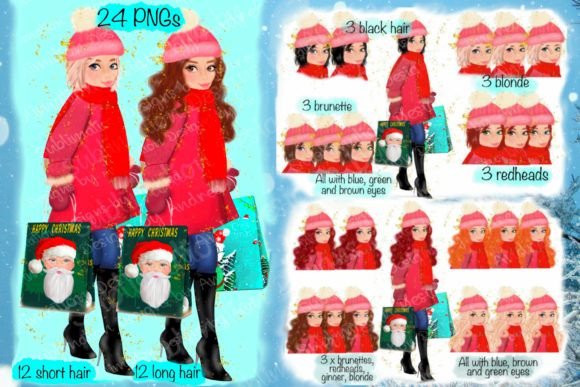
Review: 24 Christmas Dolls PNGs for Holiday Embroidery
As a designer who spends more time staring at stitch maps than most people spend watching television, I approach new Illustrations with a specific set of criteria. It is not enough for a graphic to look cute on a screen; it must survive the translation from digital pixels to physical thread. When I first opened the folder for 24 Christmas Dolls, High Quality PNGs, my initial reaction was one of cautious optimism. The collection promises a festive variety, but the real test lies in how these images hold up when digitized and stitched onto actual garments. For Etsy sellers, boutique owners, and hobbyists alike, the difference between a best-selling handmade product and a customer return often comes down to the quality of the source art.
First Impressions and Visual Personality
The immediate mood created by this collection is nostalgic and whimsical. These are not generic, clip-art style figures; they possess a distinct personality that suggests a storybook origin. The lines appear clean, and the shapes are well-defined, which is crucial when you are preparing a machine embroidery design. In the world of embroidery, vague edges and muddy details result in messy stitching. From a layout perspective, having twenty-four unique options provides incredible flexibility. Whether you are creating an advent calendar series or mixing and matching motifs for a custom apparel line, the variety prevents visual fatigue.
The detail level seems balanced for the intended scale. They are intricate enough to be interesting but not so dense that they would require microscopic precision to stitch out. This visual personality fits naturally into projects that aim for a "heirloom" feel rather than a mass-produced aesthetic. For a craft business looking to establish brand consistency, these assets offer a cohesive look that can tie together an entire holiday collection.
Real-World Application: The Holiday Tote Scenario
To truly evaluate these files, I imagined a specific real-life scenario: preparing a run of limited-edition canvas tote bags for a local holiday market. Canvas is a forgiving fabric, but it has a distinct weave that can swallow up fine details if the design isn't robust. Selecting one of the dolls from the 24 Christmas Dolls, High Quality PNGs set, I visualized the digitizing process. The clear outlines would allow for crisp satin stitch borders, while the internal areas could be filled with a textured fill stitch to add depth without excessive bulk.
In this context, the high resolution of the PNGs is a significant advantage. When scaling the image up for a large tote or down for a baby embroidery project on a onesie, pixelation is the enemy. These files appear to maintain their integrity during resizing, which is essential for a small shop product line where you might need the same motif on a hat, a towel, and a pillow cover. A customer holding a finished tote bag with a sharp, clean embroidered doll is far more likely to trust the quality of your brand than one where the threads look blurry or disconnected.
Navigating Fabric Textures and Hoop Constraints
While the source art is strong, the success of the final embroidery project depends heavily on execution. There are specific scenarios where one must proceed with caution. For instance, if you are applying these designs to stretchy fabrics like jersey knits for sweatshirt embroidery, the stability of the design becomes paramount. Complex shapes can distort if the fabric shifts, so using the correct stabilizer is non-negotiable. I would recommend a cut-away stabilizer for these garments to ensure the doll retains its shape after multiple washes.
Similarly, working with dark fabrics presents a challenge. If the original PNG relies on white space or light colors for definition, stitching on black navy requires careful planning of thread colors. You may need to adjust the underlay or add a backing layer to prevent the dark fabric from peeking through the stitches, which can ruin the visual appeal. Furthermore, curved surfaces like caps demand a different approach. The center of a cap is a small, restricted area. Not every doll in this set of twenty-four may fit comfortably within a standard cap hoop size without losing proportion. It is vital to measure the specific motif against your hoop dimensions before committing to a production run.
Technical Considerations for Professional Results
For those converting these Illustrations into a usable embroidery file, attention to stitch density is critical. High-quality PNGs can sometimes deceive the eye; what looks like a smooth gradient on a monitor might translate to an overly dense block of thread that causes puckering. My advice is to always test the design on scrap fabric first. This allows you to check for tension issues and ensure that tiny details, such as facial features or small accessories on the dolls, do not become lost in a sea of thread.
It is also wise to create black-and-white mockups before stitching. This helps you verify that the contrast between different elements of the design is sufficient. If two adjacent areas have similar values, they will blend together once stitched, reducing the clarity of the image. Additionally, consider the type of stitch used for different elements. While satin stitch offers a shiny, premium look for outlines, a running stitch might be more appropriate for delicate internal details to reduce bulk. For larger areas, an applique design approach could be considered if you want to introduce different fabric textures, though this changes the workflow significantly.
Commercial Viability and Brand Value
From a business standpoint, the 24 Christmas Dolls, High Quality PNGs collection offers strong potential for increasing buyer engagement. Unique, character-driven designs tend to perform better on social media and in printable mockup galleries than generic snowflakes or trees. They invite storytelling, which is a powerful tool for digital product sellers and commercial embroidery professionals. However, before listing any finished product for sale, you must confirm the licensing terms. Ensure that the license covers commercial use if you intend to sell physical items or digital derivatives.
Ultimately, the value of these design assets lies in their versatility. They can elevate a simple kitchen towel into a cherished personalized gift or transform a plain apron into a statement piece for a bakery owner. The professionalism of the final output reflects directly on the creator. By taking the time to select the right fabric, optimize the digitizing settings, and respect the limitations of the medium, you can turn these digital illustrations into tangible products that customers love. Whether you are a seasoned decorator or a weekend maker, treating the source file with respect ensures that your holiday embroidery stands out in a crowded market.